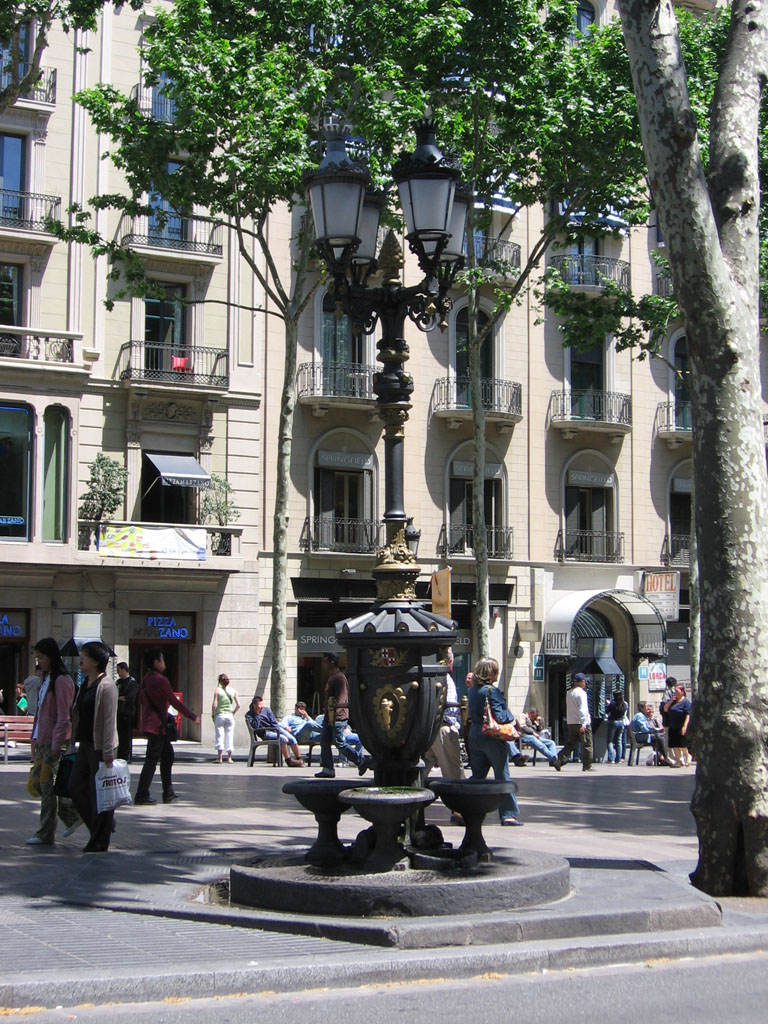
Sunday, September 18, 2011

Hasta la Próxima Vez

Well, I have one more full day in Catalunya left.  I just finished up my last two interviews today, for a grand total of 35 interviews…which is 15 more than I needed!  This trip has turned out to be a very successful one, both personally and professionally.  Personally, I was able to travel throughout a country that I love very much and explore new places that I didn’t get a chance to see the first time around.  Last year, I was over here and I needed to get out and see the rest of Europe, but I didn’t really see much of Catalonia.  Over the last 3 weeks, I was able to visit the capital of each of the 4 providences of Catalonia and some other really cool sights like Montseny (a large mountain range) and La Costa Brava (the beaches of Northern Catalonia).  Professionally, this trip has confirmed for me that I am pursuing the right career.  My research gives me the opportunity to travel, see new places and talk with locals about the things that matter most to them.  Travel + Meet new People + Being Paid to do it = my dream job.

However, before this trip I would it would be a perfect balance between work and play, but it actually turned out to be more work than I thought, though I’m not complaining at all.  It took a lot of time to coordinate all the interviews, seeing if all the people from the town could meet on the same day but at different times, getting to the places, and then finally doing the actual interview.  I would come back to my hostel at night pretty tired and if I had a day off of interviews I would only visit one or two things because I was just so beat.  And then while I was over here, I had to finish up editing my Fulbright application, so that (hopefully) I can come back to Spain next year and teach English for an academic year.  It doesn’t help too that I scheduled my return flight for the day before classes start; Wednesday I have class from 9:30-3:18…luckily my last professor is my thesis advisor, so hopefully he’ll understand if I pass out in the middle of his class, jajajaja.

And this is why I didn’t get a chance to write in my blog in as much detail as I did the last time around, and for that I’m sorry.  But of course, I will be more than willing to tell everyone about my trip if you just ask me about it ;)

So the plan for tomorrow is to wake up at around 10-11, do a goodbye tour of Barcelona (Parc Güell, Passeig de Gràcia, La Rambla and the Gothic Quarter), head back to the hostel to eat and then head off to the beach town of Sitges, about a 30 min train ride from Barcelona.  I went to this town last year and really enjoyed it, but I didn’t get a chance to visit the beach.  So, I’m going to relax and work on a nice tan (to show off to everybody that I went to a place where there’s lots of sun, haha) until the sun sets, at which time I will drink a mini-bottle of cava (Catalonia’s champagne), toasting to a fantastic trip.  Finally, I will find a decent restaurant to spend the rest of my money at, because God knows I need a decent meal (I’ve been living off of sandwiches, salads and pasta the entire trip).  Tomorrow will be a good day, hopefully a very relaxing last day of summer.  I could use one.

As with the last time I left Catalunya:
  • I'll keep my blog open for students and those curious about Spanish and Catalan culture
  • If I receive a grant to teach English in Spain next year, I will start writing again
  • My photo albums of my trip, Catalunya '11, and Catalonian Nationalism (a carry-over from last time) are complete and ready to be viewed in their entirety :)
  • Drinking from Canalets again so that I am  guaranteed to return to Barcelona
Until we see each other again, fins després Catalunya

Monday, September 12, 2011

L'onze de Setembre

September 11th, is a dark day for both Americans and Catalans alike.  On September 11th, 1714 Spanish troops seized the city of Barcelona during the Spanish War of Succession and made the Catalans surrender.  Over the next few years, the Spanish king banned the Catalan language and basically just suppressed the hell out of Catalonia.  So it’s for this reason that on September 11th the Catalans celebrate their National Day, aka “La Diada.”

I was fortunate enough to see La Diada last year, it was during my first week in Barcelona.  Last year I went to an organized event by the Generalitat (Catalonia’s government) and got to walk about their parliament building.  This year I took a walk around Arc de Triomf, where they have a big Catalan flag with the blue triangle and star (the flag for Catalan independence) hanging between the arc.  Around the walk from the Arc to the Parc de la Ciutadella there were many stands selling all sort of Catalan nationalist items, like flags, pins and scarves.  There was even a booth headed by two Basques, because some people view Euskadi (the Basque Country) and Catalonia as “brothers,” because they are both distinct nations within the Spanish state.  I thought it was a nice show of solidarity that a few Basques showed up to celebrate the National Day of Catalonia.

The main event of the day is the laying of floral offerings on the monument of Rafael Casanova, who was commander in chief of Catalonia during the Siege of Barcelona in 1714.  Because of his resistance to Spanish forces he’s become a symbol of Catalan nationalism and for this reason the people of Barcelona pay tribute to him on their National Day.  When I was there, the castellers (Human Tower builders) from my old neighborhood of Sants were there, paying tribute by building a mini castell and placing their floral offering onto the statue.

Later in the day, I meet up with my Catalan friends and we walked around looking at the stands and then later watched one of my favorite Catalan groups, Obrint Pas.  All around me it seemed like everyone was either wearing the independence flag or had a sticker on their shirt that had some reference to independence from Spain.

Now some of you may be wondering, “why do so many Catalans want independence, they’re Spanish after all.”  The answer is that many of them don’t feel Spanish at all, they are only Catalan: it’s their language, their culture and their way of life.  Catalan culture has castells, pa amb tomàquet and cava while Spanish culture has bulls, gazpacho and sangría.  One participant summed up it perfectly when he said “Spanish culture is the culture of the center and south of the country, they don’t incorporate aspects Catalan and Basque culture into the national ‘Spanish’ culture; so why are people surprised that I don’t feel Spanish, my culture is not represented in Spain.”

Furthermore, many of them feel like Spain is constantly repressing them, saying you can’t do this or that.  The most recent example is the decision by the courts that Spanish is to now be the language of the classroom, alongside Catalan.  Since the 80s, Catalan has been the vehicular language in the K-12 education in Catalonia, which is to say that every subject (except Spanish) is taught in Catalan.  The argument for this was that every child that comes to Catalonian schools, whether they be 6th generation Catalans or child of African immigrants, will learn to speak Catalan in order to promote the use of that language and to facilitate integration into the community.  Very few people had problems with this method of “linguistic immersion” as was shown in poll after poll.  However, three families demanded that their children be instructed in Spanish, brought their case to the courts and won.  What the Catalans fear is that with this decision the Spanish and other immigrants to Catalonia are going to have their kid instructed in Catalan, while the Catalans will continue to be instructed in their native language.  This could be problematic for two reasons:

a) It will endanger the Catalan language.  In the 70s, there was a massive amount of immigration from the poorer regions of Spain to Catalonia and the children of those immigrants learned to speak Catalan.  Today, those people don’t identify with the region where they parents are from, they are Catalan and are from Catalonia.  It’s their culture, it’s who they identify with and it’s partly due to the Catalan immersion they received as a kid.
b) Having the parents either chose Spanish or Catalan for their child will create a division within the kids, which is possible to last for a life time.  No one wants to split the kids into two groups because this will just foster more negative feelings towards one another.

Through my interviews I’ve noticed that people in Catalonia are just fed up with the Spanish government.  They pay view high taxes here which then goes to the Spanish government to be divided up amongst the other Autonomous regions in Spain; of course, Catalonia receives very little of that money back.  They don’t have control over taxes like the states in the Unites States do and they want more control over their money because they have things they would like to improve in their country.

Basically, I think the best way to sum all this up is with a great metaphor from my friend Laura: “Spain is like the parent that keeps on saying ‘no, no don’t do that, that’s not allowed’ and Catalonia is like the child.  If you keep on hearing this over and over what are you going to do when you’re 18?  ‘Bye guys, I’m fed up with you, I’m outta here.’”

Here are some videos I took and you can also check out my pictures in the Catalan Nationalism photo album that I started last year.

The Castellers of Sants:


Singing "Els Segadors," the national anthem of Catalonia:


Obrint Pas (a very pro-independence group) performing "Seguirem" off of their new album Coratge, near the Arc de Triomf on La Diada:


Wednesday, September 7, 2011

Week Two Update


So, I’m in the middle of my second week in Catalonia and my research project is coming along very nicely.  I’ve gotten some really great interviews, in terms of what I’m looking for and also it’s interesting to me to see the wide variety of opinions I get when I ask the same questions.  For example, I ask every participant what the significance of FC Barcelona’s slogan “Més que un club” (more than a club) is.  From my experience over here last year, I came to view the phrase as an expression of Catalan nationalism, which is to say that FC Barcelona represents Catalonia as a nation since their own national selection team is not officially recognized when they play in international matches.  However, some participants have been telling me that the phrase is in relation to how FC Barcelona represents Catalan values such as hard work and humility, while others say that it’s because those who support Barça are part of a family, a community of people who come together to support a common cause.  I’ve gotten 14 interviews so far, with about 10 more scheduled for later this week, so I’m going to have more than what I need :)

For sightseeing, I’ve done plenty of that over the last few days or so.  I stayed in Barcelona for the weekend and just did some re-sightseeing of L’eixample and the Gothic Quarter.  I also went to a few of the Magic Fountain of Montjuïc show’s, which in the summer is when the fountain is set to music and lights.  This year, one show was set to Disney songs….en español (I got a good laugh out of that).  Also, on Saturday I went to Las Arenas mall in Plaça Espanya, which was not finished when I was in BCN last year.  Basically, the city took an old bullfighting ring and converted it into a mall (since you know, bullfighting has been outlawed in Catalonia as of the 1st of this year).  The mall had some pretty nice shows and a great view of Plaça Espanya at the top level (I also got a great buy on a FC Barcelona t-shirt here, only 13€!)

As for going outside of Barcelona, I did so on Sunday and Monday.  On Sunday I went out to Lleida, the capital of the western providence of Lleida (naturally).  There wasn’t really much to do in the town (I was joking with one of my friends that it’s like the Toledo, OH of Catalonia).  For this reason, I was surprised that they actually have a tourism office in the town.  The only thing to really see was La Seu Vella, which is an abandoned cathedral on top of the city’s hill, a monument you could see for miles away.  One thing that really surprised me about the city was the amount of immigrants (mostly Africans and Muslims).  They definitely seemed to outnumber the Catalans in the city and I found out from one of my participants that they come here to work in the fields.

On Monday I went to Girona, which is again the capital of the Girona providence.  This city was definitely a lot more interesting than Lleida as it was so much more beautiful.  A river divided the city and for a few blocks on each side there are different colored houses lining the river.  It’s better for you to look at my pictures than for me to describe it because unfortunately I don’t know much about the history of all the buildings, as I didn’t take a guided tour of the city.  The coolest part was that you can walk on top of the old city’s wall and it gives you great views of everything.

Yesterday, I went back to see my old host mom (Lita) and it was an incredibly surreal experience.  She greeted me with the traditional petons (kiss on each cheek) and then we went to the living room to talk and catch up.  Her mom is also staying with her this mom and José was there too, so it was great to see them again too.  The first thing my host mom commented on was how apparently I look thinner than the last time she saw me (that or my large shirts give the impression that I’ve lost a lot of weight, hahaha).  When I was talking with them it was just like old times, my Spanish was flowing perfectly and I could understand everything they were saying.  José even brought up our old inside joke on how I my tongue gets tied when I try to say “A reveure,” Catalan for “see you later.”  Lita remembered that my favorite dish is tortilla española, so of course she made that for dinner.  I also meet the new girls who are staying with her this semester and gave them a little bit of advice and told them about my time studying abroad.

After dinner, Lita told me that she had a problem with her laptop and asked if I could look at it.  She told me that I was going to laugh a lot when I saw her problem and I did…apparently, her background is a picture of me and my sister on my birthday, with stupid expressions on our faces and Lita didn’t know how it got there nor how to get it off.  What’s even funnier is that the picture is zoomed in mostly on my sister’s face, with her eyes bulging out at you.  I laughed quite a bit, it’s funny to think that for the last couple of months every time Lita starts up her computer she has to stare at that picture of my sister and I.

Shortly after that I had to say goodbye to everyone and this is where everything quickly turned bittersweet.  It was tough saying goodbye to all of them again, especially since one year ago yesterday was when my roommate and I moved into Lita’s apartment.  So needless to say on the metro ride I was feeling a mixture of emotions.

I feel better today and since I have no interviews scheduled I think I’m going to do some more sightseeing and get a tour of the Palau de Musica Catalana, a modernist-style music hall that is famous as being a staple of Catalan architecture.  Next week, on Sunday I’m going to be with my Catalan friends celebrating La Diada, the National Day of Catalonia and then on Monday I’m off to Lleida again to do some more interviews.  Hopefully I should have some pictures of Barcelona up this week by Friday, and pictures/blog about La Diada on Tuesday/Wednesday of next week.

Until then, “a reveure”

Thursday, September 1, 2011

Week One Update


First blog post from the field!

The plane ride over was not very good.  There was a pair of children 3 seats ahead of me who would randomly start crying, I’m guessing because their ears were popping.  Also, I had this old guy next to me who was insistent on putting his knee/leg on my side…even though I was taller than him.  Of course the kicker in all of this is that I didn’t really get any sleep, maybe 2-3 hours max because it’s really hard for me to sleep on planes.  So after an 8-hour flight, we arrive in Barcelona and I realize that I haven’t spoken Spanish since my last Spanish class, which ended in June.  Joder.

After waiting in the exchange line for an hour, I take the bus to Barcelona, transfer to the metro and go to my hostel.  The hostel is in a very residential area of Barcelona, on the opposite side of town from my old host family.  As I’m walking through the neighborhood I start to feel this really weird sensation, like I’m in this surreal dream (and not in a good way).  I didn’t really feel excited to be back.  I think it’s because I was sleep deprived and dehydrated because after that Sunday and Saturday of rest and getting everything set up (phone, internet, scheduling interviews for that week) I felt much better.

So far I have interviewed 8 people, which is more what I thought I was going to get in the first week.  Only 3 of those interviews were in Barcelona so for the other ones I had to travel outside BCN to other towns to interview the people: one in Reus (Monday), two in Figueres (Tuesday) and two in Tarragona (Wednesday).  The interviews have been going very well so far, the people are very happy to sit down and share their beliefs and opinions on Catalan culture, politics and language.  I’m also finding what I came over here looking for so that has been a big relief for me.

Needless to say, I’ve had some bumps along the road so far.  A major sticking point has been my Spanish.  As I said, as soon as I got off the plane I knew that it would take awhile for it to come back to me.  I went to Vodafone to set up my Internet and phone on Saturday and literally my mind could not form a coherent sentence in Spanish.  Furthermore, my mind couldn’t process anything the guy at the store was saying so I left frustrated and defeated.  However, my Spanish is finally coming back to me, not to the level I was at when I left but it’s getting there. 

One good thing is that I’m starting to feel like a Spaniard/Catalan again.  When I first got here on Saturday I felt like a fish out of water again.  This feeling started going away yesterday, when I had a very successful day of interviewing three different people and thinking “hey, I was able to navigate myself through three new cities I’ve never been to, without any problems; that’s pretty cool.”  So, por fin, I feel comfortable again walking around the city and confidant that I can blend in with everyone else to the best of my ability.

Now, on to the sightseeing!  I didn’t do any in Reus because I was more concerned about getting my first interview and making sure everything went ok than about checking out the city.  The first sightseeing that I did was in Figueres, which is home to the Salvador Dalí museum (which the artist actually designed himself).  Although the museum didn’t have some of Dalí’s more famous works, the place still had a very interesting collection: a combination of drawings, paintings, sculptures and jewelry.  I did also see a little bit of Girona that day because I had a scheduled interview there but unfortunately I got lost in the old part of the city and didn’t make it to the interview; also, as I was very tired and frustrated, I left the city without taking many pics.  Yesterday I was in Tarragona, which was the old Roman capital of the Hispania providence.  My last participant for that day gave me an informal tour of the old part of the city as well as the city’s history museum, which was in the Roman city’s walls.

Tomorrow, I’m going to do some sightseeing around Barcelona; even though I’ve seen all these places it’s still really cool to go back and visit them.  Then on Sunday I travel to Lleida and on Monday I will be in Girona to do some more interviews.  Hopefully that means I’ll have more pictures up by next Tuesday/Wednesday and maybe even another blog post by then, ¿quién sabe?

Speaking of pictures, the ones I’ve taken so far are up on the side bar under the title “Catalunya ’11.”  ¡Qué los disfrutes!

Thursday, August 25, 2011

I'm Back...

So I knew I kept this blog open for a reason…I’ll be back in Catalunya for three weeks from August 27th to September 19th.  However, this time I am going for a very different reason and that is to start my career.

You read that right; career as in something I want to do for the rest of my life, as opposed to a “J-O-B,” something that I do to pay for school/living expenses.  I want to stay at THE Ohio State University for graduate school in Hispanic Linguistics and eventually become a professor.  However, since OSU’s program is competitive I needed to get a head start on the application process and conduct my own original research as an undergrad.  So, with the help of an outstanding advisor, I’ve developed a research topic to study: how Catalan influences the Spanish language.  However, the catch to studying this topic is that I need to talk to actual Catalans in order to have valid data, and you’d be hard pressed to find a Catalan living in the United States, let alone Columbus…

So, I submitted a research proposal to the Arts and Sciences Honors Committee and I was fortunate enough to be awarded a research grant that allows me to go over and spend three weeks back in Catalunya.  During the time that I’m over there I’m going to be traveling throughout Catalunya, interviewing people about their lives, opinions and beliefs.  Hopefully, this project will spur more ideas for possible research topics in graduate school but if not at least I’m going to be getting valuable field experience.

I’m excited to be going back, especially since this time around I’m going to be doing a lot more traveling inside of Catalunya to places that I didn’t get to visit the first time around, like Girona, Tarragona and Figueres (the home to the Dalí museum!).  Also, I’m going to be over there again during the National Day of Catalonia, so I’m hoping I get to spend that day with my Catalan friends, celebrating one of their most important days of the year :)

Unfortunately, I will not be over there to see La Mercè (September 23-25) because OSU starts classes on the 21st, but at least I got to see the festival last year.

Any who, I really don’t know at this point how much I’m going to be writing during the 3 weeks; it just really depends on how much down time I have to describe everything.  I’m shooting for 3 to 5 posts, but don’t hold me to it ;)

Oh and I’ll create a new facebook photo album for my trip that will be public and on the side bar (I think I'm gonna name it "Catalunya '11")!

Finally, remember this picture?


I knew there was some truth behind the belief that if you drink from the Canalets fountain you’ll eventually come back to Barcelona.  So here I go, ¡me voy!

Monday, December 20, 2010

The End (for now)

Well this is it.  It’s hard to say goodbye.

I’m leaving Barcelona tomorrow to head back the States.  This trip has been a blast and a real eye-opener; I’ve meet a lot of great people and seen a lot of cool places.  I wouldn’t trade my experiences for anything in the world and I am thankful to all the people who have helped make this possible (mainly my parents, Michelle and all my Spanish teachers who inspired me/gave me the travel bug).

The best adjective to describe my current state is bittersweet.

As I'm trying not to be sad I will instead chose to reminisce.  Here are some of my top favorite things from my 4-month adventure (in no particular order):
  1. Euskadi: What can I say, without the first two and a half weeks in the Basque Country I would have been very overwhealmed when I got to Barcelona.  Arantza and Maren are probably two of the coolest people I have ever meet in my entire life and I don’t know if they will ever realize how much they mean to me.
  2. La Mercè: After this festival in Barcelona I really started to feel like I was at home.  It was the best weekend of my life as I got to see what it truly means to be Catalan. 
  3. El Clásico: Seriously, this night was so much fun.  Got to watch a great game between FC Barcelona and Real Madrid (by great I mean we sent los madrileños home in disgrace) and then I got to celebrate the victory with the rest of Barcelona at Canalets.  Oh yeah, and getting to see three Barça games in Camp Nou was pretty swell too ;)
  4. Living in a host family: Whether it was fighting to get out of the apartment without that neurotic dog Terri knowing or talking with my host mom I absolutely loved living with a host family.  Rafeala cooked good food, helped us practice Spanish and she always got a kick out of it when I would sit down and watch her Catalan soap opera with her (don’t judge, I really wanted to learn Catalan!)  I also had the pleasure of meeting her mom as she stayed with us 2 out of the three months.  I couldn’t understand her half the time (Andalucian accents are really hard to understand) but she would always smile everytime I came in the room.  Her “he-he-he” laugh was absolutely adorable and she always affectionately referred to me as “chiquito.”
  5. Metro: I absolutely loved taking the metro everyday, there was never a dull moment.  I got to play my favorite mental game everyday (guess where that tourist is from!), people watch and one day I was treated to the spectacle of watching kids fall over like human dominos.  However, my favorite part of the metro is the tone that would announce what station we were approaching (hmm-hmm-hmm-hmm-hmm, pròxima estació: Badal).  I’m not going to lie, my roommate and I love the metro tone so much that for the last month we would record it on his iPhone.  I have quite a good collection of metro stops now, and I’m thinking about turning them into ringtones.  Don’t judge me, I know I’m a nerd :)
  6. Weekend trips: Seriously, I got to see so much while I was over here.  I was fortunate to visit Bilbao, Valencia, Paris, Rome, London, Edinburgh, Venice and Dublin in addition to going back to Madrid and Toledo.  I wish I could just drop everything and travel for the rest of my life but apparently I have “responsibilities” :(
  7. Kiss Hello: In Spain it's common for men-women and women-women to great each other with two light kisses on the cheeks.  I wish we would do that in the States, it's so much more friendlier than a handshake.  Everyone does it too, even if there's a big group of 8 you go around and kiss everyone on the cheek (I saw this standing outside of Camp Nou and it was quite comical).  If anyone back home wants to do this when we greet each other just let me know :p
  8. Barcelona: I got to live in the most beautiful city in the world and I will fight anyone who disagrees with me on that.  
  9. Catalan language and culture: Seriously if you haven’t noticed I've really come to identify with the Catalan culture.  I got to experience some of their traditions, I learned about their history and, most importantly, I got to learn their language.  Although I can only string a simple sentence together in the present tense I’m going to continue studying Catalan on my own so that when I come back I speak it.  This entire time I never really thought I was in Spain; I was in Catalunya and I’m completely fine with that (in fact I wouldn't have had it any other way).
I’m not really sad though because I know that I will return to Catalunya, it’s just a matter of when.  As soon as I get home I’m going to be plotting my return to the country I love and I have a couple of things in the works that will allow my swift return.  But until that time comes it’s going to be painful for me to be away from my adopted country.  I can already see it now: me sitting in my room, listening to either Obrint Pas or Lluís Llach while starting at a map of Barcelona repeating the phrase “la meva terra és Catalunya” over and over.

Some last minute housekeeping things:
  • By Thursday all of my photo albums will be completed and can be viewed in their entirety off on the sidebar 
  • My youtube page is also fully updated with videos of La Mercè, FC Barcelona and some other random stuff.  Here’s the link or you can watch some of the videos off to the side 
  • If you're looking to read about a specific topic (like advice for Spanish students, culture, Catalunya ect) you can take a look at the side bar to see the topics of this blog.
  • I am going to leave this page up for two reasons.  1) A resource for students who are thinking about studying abroad.  2) When I come back to Spain/Catalunya I will start to blog again using this very same channel.
I hope you guys liked my blog.  I started it with one objective in mind: to give you a window into a different culture and hopefully in the process you learned something interesting.  It was a pleasure writing for you guys and I hope you had as much fun reading it as I did retelling my adventures.

Finally, if any of you have any questions or comments please feel free to contact me at seanmckinnon.80@gmail.com; I’ll be happy to answer any question about what it’s like to live abroad, what the Spanish/Catalan culture is like ect.  Fan mail is also appreciated ;)

I believe I covered everything so I will end with this: until we meet again Catalunya…adéu.


Sunday, December 19, 2010

Advice for Studying Abroad in Spain

So, my time in Spain is up.  Many students came before me in Spain and plenty more will come after me.  Those of you who are choosing to study abroad are very wise, so allow me to impart a few words upon the wise...
  1. Live with a host family and spend time with them: I know it may be tempting to spend every night out with your American friends getting your party on but remember, you can do this back in the States.  You’re in Spain, go emerge yourself in the local culture!  This includes, hanging out at home and talking with your host family.  Now I'm not saying that you should spend every living second with them but spend some time with them.  If you show them even just a little bit interest in them and their way of life they will open up a lot.  Seriously, I probably learned more talking to locals than I did in any of my classes.
  2. Try to meet some locals: I know that you all probably want to do this but I’ll put it in here as a friendly reminder.  I answered a flyer to help two Catalans improve their English and it was an incredibly rewarding experience.  Not only did I get to talk and hang out with them but I also figured out what I would like to do after graduation: come back and teach English in Spain.  Now, this may not happen, but I’m going to try my hardest to make it come true.  Again as with the host families, your new local friends will help you improve your Spanish, teach you about their culture/ideas and show you the cool spots in the city. 
  3. Learn some words in the local language (Català, Euskara or Gallego):  If you’re in Catalunya you don’t say “adiós” you say “adéu.” and in Euskadi (the Basque Country) it’s “agur.”  Little things like knowing how to say good morning/afternoon/night, thank you, please in the local language will go a long way.  Plus I enjoyed learning another language in addition to improving my Spanish and I’m sure you will too, after all that’s why you are continuing to study Spanish, right?
  4. Try to be politically correct: This goes a long with #3.  What I mean by this is recognize that people in your autonomous region (namely Catalunya and Euskadi) might not consider themselves to be Spaniards but rather Catalonian or Basque.  They have a different customs and languages from the rest of Spain and you need to respect that.  So when you’re talking make sure you differentiate whether you’re talking about Spain as a whole (that is away from where you are) or your autonomous region.  Furthermore, it’s CASTELLANO not español.  I can’t stress this enough; you’re teachers will be understand if you call it español but to other people it has a very negative connotation.  Note of caution though, this may not apply if you’re in Andalucía, the two Castillas or Madrid.  As I didn’t spend much time there I really don’t know their attitudes about a pluralistic Spain so it would be best to just observe before you open your mouth.  
  5. Don’t think about what you’re saying, just say it!:  Don’t worry about making errors with your verb tenses and don’t let it hold back your sentence fluidity.  9/10 they will know what you’re trying to say and it will make the conversation much more natural.  I found that if I tried to plan out what I was going to say it would always come out f-ed up but if I just spoke without giving it much thought it came out nearly perfect.  Furthermore it wasn’t until I stopped worrying about “oh am I becoming fluent?” that I actually started to improve.
  6. Study food vocabulary: Half the time when my host mom asked me if I liked something I would turn to my roommate so that he would type the word into his iPhone Spanish dictionary app.  It probably helps too if you know a little bit about the local cuisine before you come over.
  7. Travel Travel Travel!For God’s sake, you’re in Europe!  You may only be here once (though I certainty hope not) so enjoy yourself and travel around the continent.  However I would recommend that you also travel within Spain.  Remember, Spain is composed of very diverse regions; it would be worth your time exploring them.  Your program probably has some excursions within Spain planned for you guys (we went to some places in Catalunya, Valencia, Madrid and Toledo), but if you got a free weekend go somewhere else in Spain.  I am so happy I got to spend 2 and a half weeks in Euskadi and they are some of my favorite moments from my trip.  
  8. Save up a lot of money: Again, let’s be realistic.  Europe has a very high VAT everywhere (15-25%), you’re going to want to go to bars/clubs and you’re going to want to travel.  So put down that pair of designer jeans and instead put that money in the bank.  But even then the exchange rate will screw you, so just be prepared for how much this trip will cost.
  9. Expect to get homesick at some pointLet’s be realistic, even though you’re going to fall in love with Spain you will eventually miss the people that made up your life back home, namely friends, family and pets.  This is natural, don’t let it get to you too bad.  Even though I’m really sad to be leaving Catalunya I really am anxious to see my family and friends again (and my dog!)
  10. STUDY IN BARCELONA!Hahaha, I can’t do anything if you’ve already chosen and paid for your program but if you haven’t decided what city you want to go to may I suggest Barcelona?  The city has everything your heart desires: stunning architecture, great food, beach, good weather, fabulous nightlife and above all, the Catalan culture. 


    Lost in Translation....

Sometimes, things don’t translate perfectly and problems ensue.  Here’s a short list of some things to avoid if you don’t want to have problems (these are probably the top three errors). If you do want to have problems, do the opposite :p
  • Me gusta a ______: Since we were taught in high school that the construction “me gusta fill in the blank” means “I like _____” you would think that we can use this construction to describe how we like someone, you know as a friend/person/colleague/teacher/coach/ect.  No.  Do not use this.  It means that you like the person sexually.  The correct expression is “Me + forma de caer + bien/mal ____” (as in me caes bien (I like you) or Pablo me cae bien (I like Pablo)).  You can also use it to say how you don’t like someone, just swap out bien for mal.
  • ¡Estoy caliente!: An English speaker will say this and think it means, “I’m hot.”  No, it means you’re horny.  If you’re in a club do not say this even if it is very hot or you will have a mob of young teenagers coming after you.  Instead, say “Tengo calor
  • ¡Estoy excitado!: Again, an English speaker thinks that this means, “I’m excited” like “I’m excited to see you!”  It’s true, it does mean you’re excited…sexually excited.  Please use “estoy emociado/a” to avoid potentially awkward situations with your host family.
  • It’s not really going to cause problems but as a word of advice use “estoy cansado,” when talking about how you are physically tired (like after running 5 miles, ect.) and “tengo sueños” to say that you’re tired (as in you’re sleepy)
Whew, overwhelmed yet?  Don’t worry if you are, everything will be better once you get there and you’ll come to realize that you never want to go back home, that Spain has become your new home and where your heart will always stay.

If you have any questions about Spain, Catalunya, studying abroad feel free to e-mail me at seanmckinnon.80@gmail.com as I will be happy to help you out :)

Friday, December 17, 2010

BCN Neighborhoods

So as I have found out from my time over here each city I’ve visited has a different feel/vibe to it.  For example, Barcelona is very cosmopolitan, Rome is historic, Paris is elegant, ect.  The same thing can be said about different neighborhoods in a city, and Barcelona is no exception.

To situate yourself, here’s a map of the different neighborhoods (barrios) of Barcelona.  The main ones I’m going to talk about are Sants-Montjuïc (where I live), El Raval, Barri Gòtic, El Born y la Ribera, Barceloneta, Gràcia and L’eixample (my favorite neighborhood):


Sants-Montjuïc: This neighborhood actually has 3 sub-neighborhoods within it: Sants, Montjuïc and Poble Sec.  I live in Sants with my host family and it’s mainly a residential neighborhood.  I joke with my roommate that the only thing we have here is a bunch of old people because that’s all I really see walking around.  The most famous part of this neighborhood is Sants-Estació, the most used train station in Barcelona.  Now, Montjuïc is the main hill of Barcelona and it’s home to the Olympic stadium, a castle (which was used to suppress the Catalan people in 18-19th centuries), Museu Nacional d'Art de Catalunya and of course the Magic Fountain of Montjuïc (in the summer there’s a fountain and lights show).  Poble Sec (Catalan for “dry village”) is the neighborhood above Montjuïc on the map.  Again, it’s a fairly residential area but there are some great bars and clubs there if you want to get away from tourists.

El Raval: This is an interesting neighborhood.  It’s to the left (going away from the sea) of La Rambla (the famous pedestrian street that’s filled with street performers, cafés and venders).  It’s famous for its nightclubs, prostitution and the immigrant population (it’s also known as Chinatown).  I’ve only wandered through the neighborhood a couple of times because it’s fairly dirty and I was always worried about getting pickpocketted.  In my opinion, the best part of the neighborhood is La Boquería, the most amazing open market ever which is right off La Rambla.  There, you can find the freshest fruit, meat, seafood and [insert another type of food here] in all of Barcelona.  I love just walking through it taking in all the sights and smells.

Barri Gòtic (Gothic Quarter): This is the old part of Barcelona, you know back when the Romans called the city “Barcino.”  It’s to the right of La Rambla and it ends with Via Laietana (the street where I saw the Correfoc back during La Mercè).  For many, many years (probably from Roman times to the 8th century) this was all there was of Barcelona.  So, the best way I describe the neighborhood is that it’s a maze of narrow streets and alleyways.  You can easily get lost your first time there but as long as you know where Plaça Sant Jaume (the plaza that’s the seat of power of the local government) and the two streets that lead up to it you can find your way around.  The highlights of the neighborhood are the Gothic cathedral, Plaça Sant Jaume and Plaça George Orwell (next to the plaza’s plaque that says “Surveillance Zone en a 500m radius; oh I love it how they appreciate the irony in that).

El Born/La Ribera: To the right of the Gothic Quarter, extending all the way to the Parc de la Ciudadella.  This neighborhood used to be the rich merchants neighborhood back when Catalunya was the commercial powerhouse of the Mediterranean.  This is also where all the locals go at night to drink as it’s away from the touristy areas.  The highlight is Santa María del Mar, a beautiful Gothic church.

Barceloneta: This neighborhood has somewhat of a sad past.  It was originally built to house all the displaced people from El Born during the 1700s.  They were displaced because after Catalunya found itself on the losing side of the Spanish War of Succession the centralized Spanish government decided to build a massive fortress (La Ciudadela) to control the local population right over part of El Born.  Now a days, the neighborhood is known for its excellent seafood restaurants as it turned out to be a little fishing village due its proximity to the sea.  And of course, you can find the beach there along with a modern shopping mall.

Vila Olímpica: This was developed when Barcelona hosted the 1992 summer Olympics, which greatly boosted the city’s profile (so much that it’s now the most visited city in Spain).  It has a nice shopping center, two of the most famous towers in Barcelona and it’s home to my university, Universitat Pompeu Fabra.

Gràcia: This used to be its own village before it was annex by Barcelona during the 1800s.  It’s know for its many plazas and the small town feel, like you don’t feel like you’re in a city when you’re here.

L’eixample: My favorite neighborhood in all of Barcelona because it is absolutely beautiful.  It was designed by Cerdà when the city realized that it needed to expand back in the 1800s.  At first it was meant to be a social utopia with lots of trees and open spaces for everyone to enjoy.  Of course that’s not how it turned out but nonetheless it’s still very beautiful.  This is where the Modernist architecture “competition” took place and as a result the two main avenues (Passeig de Gràcia and La Rambla Catalunya) have some of the best examples of Catalan modernist architecture. Here’s the typical design for the neighborhood, note the open space in the middle that allows for air circulation and lots of light:

L’eixample has many subsections, including Sagrada Família and Sant Antoni.  The main things to see are La Pedrera (designed by Gaudí), Illa de la Discordia (3 beautiful and famous modernist buildings right next to each other) and Gaudí’s unfinished church of Sagrada Família.  If I were to have an apartment in Barcelona, this is where it would be.

As this is my last weekend in Barcelona, I will be taking pictures of all these neighborhoods.  They can be found here in my “Out and About in Catalunya” facebook album and it will be completely by Tuesday.

Monday, December 13, 2010

A Very Merry Catalonian Christmas

So even though I am looking forward back to Christmas in the States I have definitely enjoyed Christmas time over here in Catalunya.  There are lights up in the city over the streets and although there’s no snow here you can tell it’s Christmas time.

If you haven’t noticed, Catalunya has a lot of different customs and traditions (hence the political charged saying “Catalonia is not Spain”) and Nadal (Catalan for Christmas) is no exception.  There are two main Catalan traditions that I want to mention: Cagatió and the Caganers.

Cagatió is a very popular Christmas tradition for kids in Catalunya that centers around a little log (called Tió de Nadal) with a painted face, like so:


Beginning on December 8th and up through Christmas Eve the kids feed the Tió something small (like bread), give it some water and cover it with a blanket every night before they go to bed.  Then on either Christmas Eve or Christmas day the kids beat the log with a stick while singing songs in the hopes that it will poop out presents.  At first the kids softly beat the log while singing songs like “caga tió, caga torró, avellanes i mató, si no cagues bé, et daré un cop de bastó, caga tió!” (translation: poop log, poop turrón, hazelnuts and cottage cheese, if you don't poop well, I'll hit you with a stick, poop log!).  For good measure, the kids brutally hit the log with the stick while screaming “CAGA TIÓ!” (poop log!) before they lift up the blanket to find all the presents that tió pooped for them!  The presents are generally small though because in Spain los reyes magos (the Three Wise Men) bring the boys and girls their presents on January 6th (though Santa Clause is making inroads, just as with Halloween).

Here’s a very cute video of a Catalan kid making Tió de Nadal poop out his presents:


The other popular tradition in Catalunya is the giving of Caganers.  It’s a small statue that populates all the local nativity scenes, both the public and private ones.  This sounds innocent right?  Well the thing is, the caganer statue is a person with his/her buttocks exposed (colloquially called “mooning," I believe ;) ) with a neat little pile of poo on the floor.  Here’s what I’m talking about:


The exact origin of the tradition is unknown but it still remains very popular.  There’s a huge Christmas market, called Fira de Santa Llúcia, in the plaza of the main cathedral in the Gothic Quarter and I counted at least 8 stands selling caganers and many more selling tiós de Nadal of all sizes.  Oh yeah, and no one is sacred when it comes to caganers.  There are ones of Obama, Hillary, Bush, the Pope, Zapatero (the Spanish prime minister), Tiger Woods, the Statue of Liberty, Darth Vader, ect.  If you’re curious here’s the website where you can view and buy caganers.

Also, here’s a video announcing the new line-up of caganers for 2009!


I had no idea there was another culture out there that's as obsessed with poop as ours, haha.

Come back on Thursday if you want to see some pictures of Christmas in Catalunya, they will be here in my updated Catalonian nationalism facebook album.

Thursday, December 9, 2010

Spanish a La Calle (Parte 2)

As promised, here’s a continuation of my Spanish slang post (part one can be viewed here)
  • Tío/Tía: Literally it means “uncle/aunt” but it’s used between young people as our “dude,” as in the common greeting “¿qué pasa tío?” (what’s up dude).
  • Ni fu o fa: Pretty much translates to “neither good nor bad.”  They also say pse pse (pronounced “ship, ship.”)
  • -azo: Add this suffix on the ending of body parts and it means you use that body part to hit someone.  For example, el puño is a fist but a puñetazo is a punch.  Furthermore if you nudge your friend with your elbow (el codo) it’s a codazo.
  • Tener ganas: Very very common.  It’s used to mean you want to do something.  Like for example, tengo ganas de ir de fiesta (I feel like partying)
  • Decir cuatro cosas: Literally means “to tell four things,” but you say it when you’re really mad; ¡Voy a decirte cuatro cosas, nunca me ha llamaste…..
  • Birra: slang for beer
  • ¡Qué guay!: Used like our “cool.”  -He comprado un Ferrari.  -Ah ¡qué guay tío!
  • Mogollón:  Kind of like “más que mucho” (more than a lot).  Voy a echar de menos de Catalunya un mogollón
  • Tristón: It means sad, but you don’t know why.
  • Chin-Chin: Used when you toast everyone with glasses of wine/champagne, like our “cheers.”
  • Canguro: Literally kangaroo, but it also means “nanny” (you know, the nanny carries the children around in her pouch all the time)
  • Pagafantas: Comes from two words: paga (he pays) and fanta (the delicious pop that comes in orange and lemon flavors).  It’s used to describe a guy who really likes a girl but the girl only sees him as a friend, hence why he always pays for the fantas.  This is probably my favorite slang word that I’ve learned.
Here’s a list of words/phrase I wish I knew before I went to Spain.  Hopefully it will help you in your travels.
  • ¿Baja(s)?: If need to get off the metro/bus at the next stop you can use this phrase to politely ask the person who’s blocking you to move out of the way.  Literally it means “are you getting off?,” and if they aren’t they will move out of the way.  Of course, use the usted form for your elders and tú for middle age and young people.
  • Perdone/a: Use this if you accidently bump into someone.  Again use perdone for your elders and perdona for everyone else.  Do not use "discúlpame" as you will stick out like a sore thumb because it's super formal.
  • No pasa nada: Use this if someone bumps into you, apologizes and you want to say "don't worry about it."  Generally this is used to say "don't worry about it/no problem" but if someone is worrying about something (like an exam, forget something ect.) that's when you use the literal translation of "no te preocupes"
  • Vale: The Spanish version of OK.  Use it the same way we would use OK back in the States, except not for “are you ok?” (use ¿estás bien?)
  • Pasa, Pasa, Pasa: It's used for letting someone go ahead of you, like through the door.  Now I know that when they say it it'll sound like they're angry/agitated but they're not.  
  • ¿Me pones ______?: If you’re in a bar/café and you want to order a drink, use this phrase.  They don’t really use “quiero/quisera” for ordering drinks.
  • Igualmente: Use it when someone says “buen fin de semana,” it means “you too.”
  • Entender: Use this verb if you want to say “I (don’t) understand” instead of the verb comprender.
  • One cultural thing:  They really don't use por favor and gracias that much like how we use it all the time for everything.  Like for example, they won't really say it when a store clerk hands them their purchases, but if it's a really big favor or when asking for directions they will say it; it's just a cultural thing to get use to.  Oh yeah, and it sounds really weird to them if you say muchas gracias all the time, as I found out, haha.
I’m sure there’s a lot more but I can’t think of anymore right now :p

Monday, December 6, 2010

The Emerald Isle

So I just got back to Barcelona from my very last European weekend trip.  I would like a moment of silence please, haha.

Any who, I spent the weekend in two cities in Ireland, Dublin and Cork.  It was a very busy weekend with flights every day (Barcelona-Dublin on Friday, Dublin-Cork on Saturday, Cork-Dublin on Sunday, Dublin-Barcelona on Monday), which was very hectic since we had to worry about the air traffic controller strike in Spain (which thank God ended Saturday/Sunday) and all the ice in Ireland.  This got me thinking, why the hell did I book a trip to Ireland in the first weekend of December, why didn’t I go sooner?

Regardless, it was still a good weekend, just a very cold one.  The one thing about Ireland that was different from all the other places I’ve been to is that there were really no major monuments/landmarks to visit; it was more about walking around and enjoying the company of the Irish.

The first thing we (John and I) did in Dublin was go get something to eat at an Irish pub near the hostel, called “The Hairy Lemon.”  Right away we came into contact with the Irish culture.  We ordered a pint of Guinness with our lunch (as did everyone else in the pub) and bantered with the waiter.  The Irish are incredibly friendly, just a step above the British, and I love their humor.  They frequently pull your leg, tease you and banter back and forth with you as a way to be friendly; this is my favorite type of humor/social interaction so I really felt at ease and comfortable talking to the Irish. 

After checking into the hostel, we went to the first Guinness brewery at St James’ Gate.  Now, I’m not that big of a fan of beer but I do have to say that I’ve grown to like the taste of Guinness.  The tour of the brewery was pretty cool but the part that everyone goes for is the chance to have a free pint at the Gravity Bar.  The bar has the best 360° view of Dublin, probably because it’s the tallest building in the city (guess that shows you the Irish’s priorities).

Rest of the day was just walking around Dublin, enjoying what little sunlight we had left (it did get dark at around 4:20ish).  We walked through Temple Bar, the well-preserved medieval section of the city that’s filled with pubs.  We didn’t stop and get a pint though because we already some earlier in the day and we had a very early flight in the morning to catch. 

For dinner, we dinned in Hell.  No not the real hell (it was about 20 degrees in Dublin mind ya), it’s a pizza franchise based in New Zealand.  We stopped to eat there because they had one hell of a deal (12 inch pizza, potato wedges and two glasses of wine for 20€!).  The pizza was soooo good, but I mainly wanted to go there because of the endless possibilities for puns.  Here’s the website if you’re curious.

The next morning we took a flight to Cork, mainly because of it’s proximity to the Blarney Castle.  This is of course the site of the world-famous Blarney Stone, the rock that will give the gift of gab to anyone who kisses it.  Now when I got there, there were two things that I was surprised about.
  1. The castle was actually pretty smaller but the grounds were huge.  I thought it was going to be this grand old castle that had a million rooms and dungeons but it was actually very smaller.  That being said, it was still incredible.  We got to walk through pretty much the entire thing and the place was definitely designed for midgets (or possibly leprechauns, as a friend pointed out), cause John and I had to duck our heads through every doorway.
  2. The actually stone was part of the castle wall.  Originally I thought it was big rock off to the side on the castle grounds that everyone would just leisurely walk up to and kiss it.  No, you actually had to be somewhat brave to make the effort to kiss the stone.  As it’s on the side of the castle wall and there’s a yard gap between the stone and the floor you have to sit down, hold onto two bars and lean backwards to kiss it, as you’re looking at the ground 70 feet away.  Luckily, there were two iron bars there so that if you feel you wouldn’t fall to your deal but it was still pretty unnerving. 
After touring castle we took a stroll on the castle grounds, which I was happy about because I finely got to see “green” Ireland (as all the snow in Dublin prevented me from doing).  After that, there wasn’t much to do in the town except to walk around and see a few local points of interest (like the English market and two churches).

We flew back to Dublin the next day and it was pretty much the same as the first day, walking around seeing the sites.  The best part of the day was sitting down at a pub and enjoying a nice pint.  While we were there, an Irish guy did strike up a conversation with us starting with the apparently popular phrase “what’s cracking?”  We talked about the States (apparently he spent some time in San Diego), what we were doing in Ireland (What the f-ck are you doing here?), and sports (he surprisingly knew a lot of NFL teams).  He was really friendly and it was cool to talk to a local.  In Spain it’s a little more intimidating trying to talk to a local in a bar because you’re not on the same language level as them, but when you travel to other English speaking countries of course it becomes much easier to do so. 

I liked Ireland, and if I were to go back I would go back in the summer (even though I’m from Ohio I’m not made out for cold weather) and I would definitely try to tour more of the countryside.  I guess we’ll save that for another time…

Pictures can be seen here :)

Tuesday, November 30, 2010

El Clásico

Last night was the one of the most important days in the Catalonian calendar: the FC Barcelona v. Real Madrid game, nicknamed “El Clásico.”  Let me explain why it’s so important:

To better understand the situation in Catalunya let me describe the following hypothetical situation.  The United States has been a free and independent country for 200+ years right?  Well imagine Mexico invading and conquering the US and imposing Spanish as the official language. Furthermore, if you spoke English in the streets you would be arrested on the spot.  What if they also banned our national anthem, our flag and holidays like Thanksgiving and the 4th of July.  If this happened, would you start to feel Mexican or would you still call yourself an American?

Now change Mexico to Spain and the United States to Catalunya because that’s pretty much exactly what happened over here.  For centuries, Catalunya was an independent nation with its own language, culture and customs.  Even when Spain was “unified” under the crown of King Ferdinand and Queen Isabel in 1479, Catalunya was still able to be separate from the rest of Spain.  Catalunya first came to be suppressed by Spain following the Spanish War of Succession in the early 18th century.  Spain took control of Catalunya and built two fortresses overlooking Barcelona to keep the city under control (and of course Catalan was banned).  Catalunya enjoyed a little bit of freedom when it became an industrial powerhouse in the 19th and 20th centuries but once Franco won the Spanish Civil War it was all over for Catalunya.

Franco ruled Spain from 1939-1975 and he completely suppressed anything that was “deviant” from a unified Spanish culture, that’s to say anything that related to historically significant regions like Catalunya, Euskadi (the Basque County) and Galicia.  As a result, each of these regions saw their native languages banned and their traditional customs and traditions suppressed. 

So you may ask, how the hell does all of this relate to a fútbol game?  Well, under Franco the Catalans still felt like they were Catalans (and not Spaniards) but they had no way to express this pride without being thrown into jail; they couldn’t fly la senyera (the Catalan flag) nor speak their native language openly in the streets.  However, they could become a supporter of the largest fútbol club in Catalunya, FC Barcelona.  Anyone who was a die-hard Catalan was a fan of FC Barcelona and would wave their club’s flag as a way to “stick it to the man”; "we're still Catalans even though you try to keep us down."  The club's motto “més que un club” (Catalan for “more than a club”) comes directly from this point in the history.  This is why the game versus Real Madrid has become what it is today, a great display of the two best teams in Spain mixed with some political overtones.  It’s like the Ohio State-Michigan rivalry, but throw in regional nationalism and years of suppression into the mix.

So I went to a bar last night near Plaça de Catalunya to watch the game with the rest of Barcelona.  Even before the game, there was more people out on the street than normal and it just felt like the entire city was alive with excitement and anticipation.  The bar (Cafè Catalunya, perfect for the occasion) wasn’t too packed but there was this big table of Catalan students that made the game very interesting.  I’ve been looking forward to this game ever since I knew I was going to be studying in Barcelona and it didn’t disappoint my expectations.  Barcelona absolutely DESTROYED Real Madrid with a score of 5-0.  Barcelona looked like the better team throughout the entire match and they deserved to win.

There was one interesting scuffle in the match.  Ronaldo, the cocky Real Madrid player, pushed Pep Guardiola, the Barcelona coach after Guardiola was holding onto the ball before a Real Madrid throw-in.  As soon as Ronalado pushes him the Barcelona players come to the defense of their coach, including Barcelona’s goalie (who was yellow carded for leaving the goal area).  Here’s video of the scuffle (I don’t agree with the commentary but this was the only one I could find in English).


The best part of the game was my favorite player, David Villa (striker #7), scored two goals in the second half; he scored the first one with 54 minutes of play gone and the second one 3 minutes later.  The game ended with a stunning 5-0 score in favor of Barcelona, which was a shock to me (I thought the game would be really close, like 2-1) but of course I was ecstatic. 

As is tradition in Barcelona, whenever Barça beats Real Madrid everyone gathers at the top of La Rambla at the font de Canalets.  Here’s a picture of the fountain without the masses of Barcelona fans:


I was there for a good hour, celebrating the win with the rest of Barcelona.  Everyone was in a good mood, jumping up and down while chanting some of Barça's cheers.  I have few favorite ones that I would like to share:
  • Madrid, cabrón, saluda al campeón”: Spanish for “Madrid, carbón (a very vulgar Spanish swear word, close to our motherf-er), salute the champion.  
  • "Villa, Villa, Villa....Villa maravilla": This one refers to David Villa.  They repeat his last name and add the Spanish word for "a wonder" b/c it rhymes :)
  • Ese portugués, hijo de puta és”: This one deals with that cabrón Ronaldo.  It means “this Portuguese (Ronaldo is from Portugal), son of a bitch he is." 
  • "Visca Barça i visca Catalunya!": Catalan for "long live FC Barcelona and long live Catalonia." (a personal favorite)
Here’s my video from the celebrations:


My Youtube Video (it's probably better to just click this link):


Last night is something I will never forget (despite having a liter of beer, haha.  I asked for a cerveza and the waiter came back with huge chilled glass filled with beer).  My FC Barcelona pictures have been updated so you can see all of what happened last night.

Visca Barça i visca Catalunya!

Sunday, November 21, 2010

General Update

Just a general update for all you dedicated readers out there.

Classes are still going ok.  My Spanish language class has really been helping me with the finer points of Spanish that prevent me from advancing to a high level (mostly picky little grammar stuff and some vocab).  I did really well on my Spanish politics take home exam, especially considering I wrote the whole thing the night before I left for London.  I’ve learned a lot in that class and I probably know as much about the Spanish political system as I do about our system (I’ll hold off my judgment as to which one I think is better).  As for my Barcelona history class I’m learning a lot about the history of Catalunya.  In my Spanish 3 class in high school we did talk a lot about the history of Spain, but it mainly focused on the history of Castilian Spain and not the history of the crown of Argon-Catalunya.  So basically I’m getting a different perspective of Spain as a whole, from the eyes of Catalunya, which I find really interesting.  Again, it definitely reiterates that Catalunya is not Spain…

Speaking of which, Catalan has actually turned out to be my least favorite class.  I love the language and I hope to be fluent in it some day but this class has been somewhat of a disappointment.  The teacher isn’t the greatest and she really doesn’t conduct the best learning environment.  However, I think between learning it on my own and getting help from my host mom I’ll have a solid foundation to continue on with my studies when I get back to the States (there’s a good website for teach yourself Catalan, sponsored by the Generalitat, the Catalonian gov’t).

Now, although I absolutely love Barcelona I’ve been battling a spell of homesickness this past week.  This is of course normal and to be expected but I think there are two reasons for this sudden spell:
  1. 3 months: Thursday (the 18th) was my three-month anniversary of being in Spain.  Don’t get me wrong, I love Barcelona and I would love to live here for the rest of my life but you eventually come to miss the people that made up your life back in the States; this is the longest I’ve ever been away from them.  Although I talk to my family over skype and my friends over facebook it still isn’t the same as talking to them face to face.  I miss my dog, I miss my pow-wows with Kristen, I miss lunches with Aunt Jean, I miss all my friends from Maumee 18/Fallen Timbers 14/Band, I miss joking around with Erica in A-band and above all I miss bantering with my sister.  I knew I would eventually come to miss all these things but I didn’t know that it would hit me that hard.
  2. Holidays: This week starts the holiday season.  While you all have Thanksgiving this week it's just an ordinary week for me.  Although I despise turkey (cold turkey being the worst offender) I wouldn’t mind having a big Thanksgiving feast with my family right now.
Whew, I’m glad that I got that out of the way.  So what do I have planned for my last month in Barcelona so that I can go out with a bang? Well…
  •  El Clásico: The football game between FC Barcelona and their bitter rivals, Real Madrid.  The game is next Monday and let's just say that it's WAY more intense than the Ohio State-Michigan rivalry (and this is coming from an OSU student).
  •  Barça game: I tickets for the FCB v. Real Sociedad game on December 12th.  It’ll be my third and last Barça game so it should be a lot of fun.
  • Ireland: I’m taking my last weekend trip to the Emerald Isle during the first weekend of December.  I’m really excited because I’ve heard nothing but great things about Ireland although I am going when it’s probably going to be very cold.  I’m going to spend 2 days in Dublin and one day in Cork, which is near the Blarney Castle.
  • Cataloging the city: This week, I’m going to be going around the city and take a million pictures, like I was a tourist.  This is so that when I feel nostalgic I can open iPhoto and go through all my pictures and so that I can show you guys how beautiful Barcelona is.  This is why I’m holding off on posting my “Neighborhoods of Barcelona” post b/c I think it would be much better with pictures, right?
As far as blog posts here's what you have to look forward to for the next month
  • Another Spanish slang post
  • El Clásico
  • Ireland trip
  • Advice for students coming over to Spain (pay attention Brooke!)
  • Thoughts about what I'm going to miss about Catalunya/Spain/Europe
  • My favorite memories, stories from my trip
  • Probably one about Reverse Culture shock when I get back to the States (I already know I'm going to have it, there's no doubt in my mind)
Pretty ambitious eh?  

2

Wednesday, November 17, 2010

Venice

Well last week I traveled back to Italy with my roommate to Venice.  There’s not really much to say except that it was as beautiful as they present it in movies.  I’m not going to do a day-by-day account of what I did because it was literally just walking around the city (which was fine by me); instead, I’m just going to give you some bullet points on what Venice was like.
  • Canal galore:  The city is composed of about 117 different islands divided by canals; literally every block was its own island.  Each canal was uniquely different from the one you saw five minutes ago so I was pretty much obligated to take a million pictures, haha.
  • Gondolas: As to be expected, they were everywhere in the city and they looked a lot more luxurious than I expected (lush carpet and comfy armchairs); no wonder why they cost 80€ for a half hour ride (obviously I didn’t go).  They all wear the traditional striped shirt, but I didn’t hear a single one sing loudly in Italian :(
  • Maze: Getting lost in Venice is incredibly easy to do as it is a city of numerous canals and narrow streets.  Besides this, the street signs are painted on the buildings so if one is faded then you’re shit out of luck trying to find out where you are.  Because of these three things, John and I got lost on the way back to the hostel on Friday night, somehow ending up in a residential area with a basketball court.  It was completely deserted, very dark and all we kept of hearing were the meows of some street cat.  It was very creepy to say the least.
  • Food: I don’t know why, but the food in Venice sucked.  The portions were small and expensive.  The best meal I had there was a 4€ toasted wrap with a coke for lunch.  This is going to sound bad but the food at the Olive Garden was better the food in Italy…
  • Masks and Glass: I didn’t know this before hand, but Venice is well known for their Carnival masks.  During Carnival, the people of Venice would wear them to hide their social status so that they could do whatever they wanted to do.  These shops were all over the city, literally there was like 5 of them on one street.  Another famous product of Venice is their Murano glass.  I don’t know what separates it from regular glass, but it’s very colorful and let’s just say that they make for good gifts…
I really liked Venice, and unfortunately for you guys it's really hard for me to describe it.  It's unlike any other city in the world and there's no way that you could compare it to anything.  So instead of me describing every detail of the city you should be looking at my pictures!